Airports of Thailand (AOT) is planning to build solar-cell power plants at its six airports nationwide.
"This is one of the projects that AOT hopes will help in cost reduction as the company aims to be a green airport in the near future," AOT president Serirat Prasutanond said last week.
The first plant will be located on 100 rai of land on the east side of Suvarnabhumi Airport in Bangkok.
AOT's board hopes it will produce about six megawatts per year or 30 per cent of the total energy consumed at Suvarnabhumi.
The first project would need Bt700 million to Bt800 million and was expected to recoup the investment within seven years.
Construction would take one year.
AOT and the Provincial Electricity Authority would hold a combined 49 per cent of the project and invite the private sector to take 51 per cent.
The investment is also in response to a carbon trade being implemented in the European Union.
The company aims to build more solar-powered plants at its other airports in Chiang Mai, Hat Yai, Phuket and Chiang Rai.
AOT is also planning to install a radio frequency identification or RFID tagging system to improve luggage sorting at Suvarnabhumi.
The system will supplement its existing barcode system, which has become inefficient.
Some leading airports in Hong Kong, South Korea, the Netherlands, Japan and Portugal have already installed an RFID tag system
On Saturday, local people and official bodies in Chiang Rai proposed that AOT rename Chiang Rai International Airport as Mae Fah Luang International Airport, Chiang Rai.
The company would hire the International Civil Aviation Organisation again to study single airport usage in Bangkok, at a cost of Bt30 million. ICAO earlier studied dual airport usage.
"AOT needs more options for the government to consider what to do with the airports in Bangkok," Serirat said.
AOT's operating results this year would be the worst since Suvarnabhumi opened in September 2006, due to the global economic crisis and domestic political problems, he said.
Passenger arrivals are expected to drop by 10 per cent from the targeted 41 million to 38 million.
Total airlines are also forecast to fall by 4.5 per cent from last year.
And the company suffered from a cutback in providing airport services to other airlines buffeted by the crisis over the past year, he added.
From The Nation
Monday, November 30, 2009
Jackie Chan flies out of Bangkok Airport
| |

From Pattaya Today


Lower airport fees should continue, says Cathay COO
Cathay Pacific has confirmed that it is in talks with Hong Kong Airport Authority in order to negotiate an extension on the discount airport fees that it is currently paying. With the 10% off normal prices deal set to run out this year, and only put in place temporarily due to the Global Financial Crisis, Cathay is of the opinion that this should extend to next year reports Hong Kong's The Standard. "The rebate applies to the end of December and we are now asking the Airport Authority to extend it into next year, which would be welcomed by all airlines using Hong Kong International Airport," said John Slosar, Cathay Pacific COO, to the publication. "Looking ahead, December bookings are marginally ahead of 2008 in economy class but remain flat in the front end," he adds.? "January and February are still looking slow but that may be because of the current trend for late booking." It's understood that Qantas has also asked the airport to extend its discount to next year as well. |
From etravelblackboard
THAI boss seeks anti-AirAsia alliance
Piyasvasti calls for unity on foreign threat
Thai Airways International (THAI)'s chief executive says Thai-owned carriers should form a united front against foreign rivals, especially the fledging budget carrier AirAsia, whose rapid expansion is seen as a "threat".
"Instead of fighting among ourselves, it would be better for us, Thai airlines, to stick together, co-operate and fight AirAsia, which is the biggest threat," said Piyasvasti Amranand.
"They [AirAsia] are expanding rapidly, taking a lot of passengers away. Their Thai market share has been increasing rapidly."
In his sixth week as president of the flag carrier, the former energy minister said he was advocating "much closer co-operation" among Thai airlines such as privately owned Bangkok Airways.
The co-operation could take several forms, including a code-share agreement, feeding passengers between airlines, consolidating networks and avoiding "unnecessary" competition, he said.
But Dr Piyasvasti's view, that AirAsia is a common threat to Thai airlines, surprised Tassapon Bijleveld, chief executive of Thai AirAsia, the sister carrier of Southeast Asia's largest low-cost carrier group based in Malaysia.
"Why are they seeing us in that light? They should see us complementing them, by bringing passengers from Asean into Thailand and feeding them to Thai airlines and THAI through its Bangkok hub," he told the Bangkok Post.
Mr Tassapon added that AirAsia and THAI served different markets, with the former targeting budget-conscious travellers and the latter those seeking full services. "It is fair to say that THAI should be competing with legacy carriers such as Singapore Airlines, Cathay Pacific and Emirates, not us," he said.
Mr Tassapon asked why entities with foreign ownership, like Thai AirAsia - which is 49% owned by Malaysia's AirAsia Bhd - face discrimination.
"Do we believe in free trade and fair competition in this country?"
AirAsia's extraordinary growth has raised considerable concern among airlines, at least in Southeast Asia.
Marketed under the slogan "Now Everyone can Fly", AirAsia has now flown more than 75 million passengers and is linking cities across Asia-Pacific.
In just seven years, the airline has grown from a fleet of two aircraft with one destination and a staff of 250 to a fleet of more than 80 aircraft with 113 routes to almost 60 destinations across Asia-Pacific and a staff of 6,500.
The airline's low-cost long-haul affiliate, known as AirAsia X, also flies from its Kuala Lumpur hub to Australia, northern China, Taiwan, the UK and, most recently, the United Arab Emirates.
THAI, which will celebrate its 50th anniversary next year, has a fleet of 88 aircraft, which transports nearly 20 million passengers a year to 74 destinations, and employs 26,000 workers.
Industry sources said Dr Piyasvasti brought the issue of co-operation among Thai airlines to the public following a recent meeting with Bangkok Airways president Puttipong Prasarttong-Osoth, in which co-operation between the two carriers was discussed, without concrete agreement on the matter being reached.
From Bangkok Post Business
Saturday, November 28, 2009
The 2009 OAG Airline Industry Award results
For 27 years, the OAG Airline Industry Awards has honored the very best in global air travel. In fact, the OAG awards are considered to be the equivalent of the Oscars for the global airline industry. This year’s winners include the following:
OAG Airline of the Year 2009
Best Airline based in Asia
- Winner: Singapore Airlines
- Finalists: Asiana Airlines, Cathay Pacific, Malaysian Airlines, Thai Airways
Best Airline based in Australasia/Pacific
Best Airline based in the Middle East/Indian Sub-Continent
Best Europe to Asia/Australasia Airline
Best Transatlantic Airline
- Winner: Virgin Atlantic
- Finalists: British Airways, Continental Airlines, Lufthansa, United Airlines
Best Transpacific Airline
Best Economy/Coach Class
- Winner: British Airways
- Finalists: American Airlines, Continental Airlines, Korean Air, Singapore Airlines
Best Executive/Business Class
- Winner: Continental Airlines
- Finalists: British Airways, Emirates, Singapore Airlines, Virgin Atlantic
Best International First Class
Best Airport
OAG winners are chosen by asking frequent flyers to consider which airlines they have flown on in the past 12 months in each of OAG’s award categories. They are then asked to rank and vote online for their top three airline choices in each category and the results are calculated based upon a formula that takes into account how many times an airline was voted 1st, 2nd or 3rd by each traveler.
Friday, November 27, 2009
Promotion: Bangkok to Dubai for just 18,400 THB All Included
Fly Roundtrip from Bangkok to Dubai
- Airline : ROYAL BRUNEI (BI)
- All Inclusive Fare : 18,400 THB in Economy class
Travel from 19 January 2010 to 28 February 2010.
Call now until 27 February 2009 at +66 2 235 6624 for reservations.
Also, check out our apartments in Dubai (starting from 103 USD per day) and our serviced apartments in Bangkok.
- Airline : ROYAL BRUNEI (BI)
- All Inclusive Fare : 18,400 THB in Economy class
Travel from 19 January 2010 to 28 February 2010.
Call now until 27 February 2009 at +66 2 235 6624 for reservations.
Also, check out our apartments in Dubai (starting from 103 USD per day) and our serviced apartments in Bangkok.
Thai's Low Cost Airline Opens Three New Domestic Routes
Speaking at a news conference with executives from Thai Airways International (THAI) and Nok Air, Civil Aviation Department director-general Wuttichai Singmanee said Nok Air is assuming flights replacing the three destinations revoked by PB Air, another domestic Thai carrier.
Stoppage of the flight operations has affected the three provinces' tourism industry, he said.
Supported under the umbrella of THAI, Nok Air will use ATR-72 aircraft flying from Bangkok's Don Mueang Airport to the three destinations.
Return flights will be operated three times weekly for the Bangkok-Sakon Nakhon route on Mondays, Fridays and Sundays, for Bangkok-Nakhon Phanom on Thursdays, Fridays and Sundays, and twice a week for Bangkok-Buri Ram on Mondays and Thursdays.
Meanwhile, Nok Air chief executive Patee Sarasin said opening the new routes means that the airline serves four provinces in the northern region, including Udon Thani.
Patee said the company would also launch a 'Buy1 Get1 Free' package for its New Isaan (Northeast) Routes Promotion for those who book their flights to the three new destinations from November 26 to December 16 and travelling from December 3 through December 18, at fare prices from 2,490 baht (US$75).
From BERNAMA
Thursday, November 26, 2009
Toilet mystery on Cathay Pacific flights to Hong Kong
 One flight had to make an unscheduled landing in Mumbai |
Cathay Pacific says its fleet of Airbus planes has been hit by a spate of mysterious toilet blockages.
The problem has been so serious that one flight from Riyadh had to land in Mumbai when the crew discovered none of the plane's 10 toilets were working.
In other cases, the number of passengers boarding flights had to be restricted because of toilet problems.
Airbus engineers are now fitting new toilet pipes to the airline's fleet and carrying out deep cleaning.
Cathay spokeswoman Carolyn Leung said although the exact cause of the blockages was unclear, passengers themselves may be partly to blame.
"You would be amazed what we find in the pipes when we clean the system - not just face towels but medicine bottles, socks, items of clothing and even children's stuffed toys," she said.
The toilets use high-speed vacuum pipes to take waste at up to 110km/h (68mph) into a holding tank, which is then emptied between flights.
Any blockage usually affects all the toilets on one side of an aircraft.
From BBC News
Wednesday, November 25, 2009
Enjoy great All in Fares from Bangkok to London:
Fly Roundtrip from Bangkok to London
- Airline : EVA Air
- All Inclusive Fare : 33,000 THB in Economy class - 92,000 THB in Business class
Travel now to 31 December 2009.
Call now until 31 December 2009 at +66 2 235 6624 for reservations.
Also, check out our apartments in London (starting from 64 GBP per day) and our serviced apartments in Bangkok.
- Airline : EVA Air
- All Inclusive Fare : 33,000 THB in Economy class - 92,000 THB in Business class
Travel now to 31 December 2009.
Call now until 31 December 2009 at +66 2 235 6624 for reservations.
Also, check out our apartments in London (starting from 64 GBP per day) and our serviced apartments in Bangkok.
Tuesday, November 24, 2009
Fly Roundtrip from Bangkok to Frankfurt for TBH 32,500 All included
Fly Roundtrip from Bangkok to Frankfurt
- Airline : Singapore Airlines
- Price : THB 32,500 All included
Travel from 20 January to 9 February 2010 in Economy class.
Book on 24-25 November 2009 on Singapore Airlines website.
Also, check out our apartments in Frankfurt (starting from 70 Euros per day) and our serviced apartments in Bangkok.
Fly Roundtrip from Bangkok to Nagoya for TBH 17,000 All included
Fly Roundtrip from Bangkok to Nagoya
- Airline : Singapore Airlines
- Price : THB 17,000 All included
Travel from 20 January to 9 February 2010 in Economy class.
Book on 24-25 November 2009 on Singapore Airlines website.
Also, check out our apartments in Nagoya (starting from 10,000 JPY per day) and our serviced apartments in Bangkok.
Fly roundtrip from Bangkok to Paris for TBH 33,225 All Included
Fly Roundtrip from Bangkok to Paris
- Airline : EY (Ethihad)
- Price : THB 33,225 All included
Travel now to 10 March 2010 in Economy class.
Call now until 30 November 2009 at +66 2 235 6624 for reservations.
Also, check out our apartments in Paris starting from 51 Euros per day.
- Airline : EY (Ethihad)
- Price : THB 33,225 All included
Travel now to 10 March 2010 in Economy class.
Call now until 30 November 2009 at +66 2 235 6624 for reservations.
Also, check out our apartments in Paris starting from 51 Euros per day.
Thursday, November 19, 2009
Emirates ups Thai flights
Emirates Airlines, the Middle East's largest carrier, will introduce a fourth daily service to Bangkok next month.

An Emirates A380 superjumbo is unloaded at Suvarnabhumi Airport, where the airline is adding more capacity on its Bangkok route.
The additional daily flight to Bangkok, which is part of the carrier's two-month Asia-Pacific expansion plan to tap peak travel demand, will begin on Dec 2.
With the fourth flight, the Dubai-based airline will offer the largest capacity between Thailand and the Middle East.
Emirates is already using four high-capacity wide-bodied jets on the route, including the A380 superjumbo that can carry 488 passengers.
The additional flights would support Thailand's economic recovery by increasing tourist arrivals from Dubai and the Middle East, said Richard Jewsbury, senior vice-president for commercial operations for the Far East and Australasia.
The extension of visa fee exemptions for Thailand until March 2010 is expected to generate more tourist traffic, he said.
Cargo will also receive a push, said Mr Jewsbury.
Thai exporters of electronic parts, cosmetics, pharmaceuticals and perishables, and importers of automotive and machine parts, medical equipment, chemicals and chilled foods stand to benefit from the additional 161 tonnes of capacity per week per direction on the route, he said.
Emirates insiders said the airline hoped to sustain the fourth Bangkok flight, at least until the end of the current air traffic programme that ends in March.
The airline is also expanding its footprint in Asia-Pacific with a third daily service to Sydney, two additional flights to Manila and one to Jakarta.
A total of 17 flights per week will be added over the four cities, including Bangkok, between December and January, representing a 13% growth in seat capacity. The number of flights throughout the Asia Pacific will increase to 187 flights per week.
The airline more than doubled its profit for the six months through Sept 30 to US$204.9 million, from $77.4 million in the same period a year earlier.
From Bangkok Post
Wednesday, November 18, 2009
Fly roundtrip from Bangkok to Singapore for just THB 5,700 All Included
Fly roundtrip from Bangkok to Singapore:
- Airline: Singapore Airlines
- Price: THB 5,700 (all included)
Travel now to 15 December 2009 in economy class.
Book now until 15 December 2009 on Singapore Airlines website.
Book a serviced apartment in Singapore:
(in partnership with Moveandstay.com)
Starting from: 185 S$ per day
Apartment type: Studio - 1 Bedroom - 2 Bedrooms+
Location:Orchard - City Center - Riverside
- Airline: Singapore Airlines
- Price: THB 5,700 (all included)
Travel now to 15 December 2009 in economy class.
Book now until 15 December 2009 on Singapore Airlines website.
Book a serviced apartment in Singapore:
(in partnership with Moveandstay.com)
Starting from: 185 S$ per day
Apartment type: Studio - 1 Bedroom - 2 Bedrooms+
Location:Orchard - City Center - Riverside
Tuesday, November 17, 2009
Cathay Pacific offers passengers the option to secure seats with additional legroom
| Cathay Pacific Airways announced on November 16 that it is offering passengers the option to secure seats with extra legroom in its Economy Class cabins by paying an additional charge. There is always a strong demand for extra legroom seats, and the Cathay Pacific move is in line with similar practices adopted by other major international airlines. From 1 December 2009, Cathay Pacific customers will be able to secure an Extra-legroom Seat on long-haul flights by paying US$100 per sector. They can also pay for the seats by redeeming 20,000 Asia Miles. From 1 January 2010, passengers will be able to secure an Extra-legroom Seat on flights to Mainland China and regional destinations by paying US$25 or 5,000 Asia Miles. Members of the Cathay Pacific's Marco Polo Club loyalty programme (Silver tier and above), who are already able to reserve the Extra-legroom Seats, will continue to enjoy the service free of charge. The seats will be allocated on a first-come-first-served basis. Cathay Pacific Director Sales & Marketing James Barrington said: "Those passengers who particularly value extra legroom will now be able to secure these seats and enjoy a more comfortable journey simply by making an additional payment. At the same time, we will continue to reward our most loyal customers by offering them the Extra-legroom Seat option free of charge." The Extra-legroom Seats have significantly more legroom than other seats in Cathay Pacific's Economy Class cabins. For most flights, there are between two and four Extra-legroom Seats available.
From Financial |
Monday, November 16, 2009
Packing an airplane or travel busy bag for a child
Traveling with small children can be an interesting experience – especially if its a long flight between Asia and Europe or North America. Hence Debbie, the blogger behind the DeliciousBaby (making travel with kids fun) blog, has recently written a very helpful post about packing an airplane or travel busy bag. Debbie begins by describing the ideal airplane or travel toy as being:
- Quiet
- Compact
- Small pieces are easy to contain so that they don't end up on the floor, and loosing a piece doesn't destroy the play value of the entire toy
- Not so precious that you would mind loosing it
- Not fragile
- Preferably no batteries (or if there are batteries, make sure they are fresh)
- Engaging. Self contained crafts are especially great, but be wary of crafts that might make a mess or contain smelly glues or paints.
- Can be played with independently or with a parent
She also points out that the perfect travel toy does not have to be “expensive and intricately designed” and that you should have a good mix that will allow your child to engage in different types of play (she has also posted a helpful list of suggested items along with where you may obtain them). In addition, she notes that parents should:
- Wait to bring out your busy bag until you've exhausted all the "built-in" entertainment.
- Try not to open the busy bag in the airport terminal. As exhausted as you might be, the terminal is the place for your child to stretch their legs and, if possible, run.
- Dole out the items one by one, making sure that play is exhausted before starting another
- Consider wrapping each item. Young children are so thrilled with unwrapping "gifts" that they won't mind if you wrap something they already own.
So should you be traveling in the near future with small children, Debbie’s post and her blog in general will prove to be a valuable resource.
Beautiful All Nippon Airways anime commercials
The Japanese are the true masters of animation or anime. In fact, they have used anime to produce some beautiful commercials. One such commercial was produced by All Nippon Airways and was showed at the recent New York Anime Festival. It shows "the art of arrival" on ANA:

In this second ANA commercial, ANA 747-400Ds celebrate the opening of the new Terminal 2 at the Haneda Airport in Tokyo a few years ago:

ANA is also a member of Star Alliance and hence, the aircraft formation in this third commercial is the Star Alliance’s trade mark:

From: http://www.moveandstay.com/business-traveler-asia/2009/11/beautiful-all-nippon-airways-anime.html
Suvarnabhumi Airport Link to start week-long official test run Dec 5

The long-delayed Airport Rail Link project, providing direct rail service to and from Suvarnabhumi Airport, will officially start its test run December 5 as scheduled earlier, coinciding with the birthday celebrations of His Majesty the King, State Railway of Thailand (SRT) governor Yuthana Tupcharoen said Sunday.
During the test run, free service will be provided to the public from 9 am to 12 noon and 1 pm to 4 pm daily all week and train drivers will be technical staff of Siemens, manufacturer and installer of the rail system, as SRT has not yet received test run operation training from Siemens, said Mr. Yuthana.
The SRT board met Friday, chaired by Ministry of Transport deputy permanent secretary Thawalrat Onsira, agreeing in principle to hire Deutsche Bahn International (DBI) of Germany to administer the rail service between Suvarnabhumi International Airport and terminal stations in Bangkok.
DBI has been asked to adjust its management system to match SRT demands.
Changing an earlier agreement, SRT has been directed to renegotiate the DBI contract to maintain cleanliness at stations, the maintenance centre and the overall rail route, as the work could be done by SRT, and also calling for lower fees on the part of DBI.
A subsidiary firm to be initially called Airport Link Co., Ltd. will be established with registered capital of Bt500 million.
The 28-km rail link connects Suvarnabhumi International Airport in adjacent Samut Prakan province and the City Air Terminal in Bangkok's Makkasan area.
Transport for airport express riders and local commuters will run on the same track with the same equipment, but with a staggered schedule.
Premium-fare express services will run on the hour between Suvarnabhumi Airport and City Air Terminal, while the City Line service will stop at six local stations along the route. (TNA)
Friday, November 13, 2009
Flight promotion from Bangkok to Tokyo
Fly Roundtrip from Bangkok to Tokyo
- Airline : NW (North West Airline)
- Price : THB 16,200 All included
Travel now to 30 November 2009 in Economy class.
Call now until 30 November 2009 at +66 2 235 6624 for reservations.
- Price : THB 16,200 All included
Travel now to 30 November 2009 in Economy class.
Call now until 30 November 2009 at +66 2 235 6624 for reservations.
Starting from:14,200 JPY per day
Apartment type:Studio-1 Bedroom-2 Bedrooms
Location:Shinjuku-Shibuya-Minato-ku
Apartment type:Studio-1 Bedroom-2 Bedrooms
Location:Shinjuku-Shibuya-Minato-ku
Flights to Tokyo Haneda to be introduced by Singapore Airlines
Singapore Airlines will introduce twice-daily flights to Tokyo Haneda Airport next autumn, it has been confirmed.
The carrier will begin flights to Haneda in October 2010, which will complement its existing route to Tokyo's Narita Airport.
Singapore's Air Traffic Rights Committee has granted the airline a permit for 14 weekly flights to be operated on the route.
Haneda Airport will be able to accommodate a number of new flights once its new fourth runway opens next year, which could see it surpass Narita's status as the Japanese capital's main international airport.
The airport is expected to be a popular choice among Tokyo-bound passengers because it offers excellent onward domestic flight connections and is located closer to the city's business districts.
Singapore Airlines operates flights to three other Japanese cities, namely Fukuoka, Nagoya and Osaka.
The carrier recently entered into a new bilateral frequent flyer programme with Air India, which will afford passengers improved choice and value for money.
From Skyscanner
Thursday, November 12, 2009
Flying palace: inside the A380 private superjumbo
 Click for more photos
 The enormous size of the Airbus A380 allows it to house features never before seen on an aircraft, such as an elevator between floors. Photo: Case4de/Design Q


It's the ultimate in luxury transport fit for a king.
A British design firm is currently working on the interiors for a private Airbus A380 superjumbo VIP jet, under commission from a "Middle Eastern" client.
The client remains unknown, but could be Saudi billionaire Prince Alwaleed bin Talal, who became the first person in the world to buy the world's largest passenger aircraft for his personal use in November 2007.
While the price paid was not disclosed at the time, airlines typically purchase the A380 for US$300 million (A$370 million).
Design Q say the enormous size of the A380 - which can fit up to 853 passengers with an all-economy class fit-out - allows it to house features never before seen on an aircraft. These include a grand entrance hall featuring a floating spiral staircase that will join the three floors of the aircraft.
(Photos: Sneak peek at the luxury A380 private jet)
The front section of the aircraft leads to a large board room, that can be open to the entrance hall or closed for private meetings, and private lounge.
A separate entrance at the front of the aircraft allows passengers to board via an elevator, rather than a side door. The elevator also allows for travel between the plane's floors.
Elsewhere, passengers can relax in the marble-lined hamam (steam room) on the lower deck. A prayer room is planned for the upper deck.
"This aircraft is all about the ultimate luxury travel experience and exudes confidence and commitment on the part of the owner," says Gary Doy, director of Design Q.
Among the other feature reportedly planned for the luxury giant are a "wellbeing room" that will feature a display screen floor showing the ground beneath the plane, a concert hall with a stage and seating for 10, and five luxurious private quarters.
The extravagant designs present their own problems for engineering partners Case4de. "There are many technical and certification challenges on this project however we are confident given the experience we have of this aircraft that the concept we have developed with Design Q is feasible," managing director Noureddine Madoui said.
Planespotters will have to wait to find out: the A380 superjumbo private jet will not be ready for three years.
From TheAge
The future of airline seating: watch this space

Click for more photos
Jacob's business-class model, which creates a second storey of seats has the potential to double the capacity of conventional business-class design and afford more privacy.


Passengers want more room, airlines want more seats. Kay O'Sullivan finds designs that might satisfy everyone.
Design Q is a British firm with an impressive track record in aircraft interior design. The company was responsible for Virgin Atlantic's much-vaunted Upper Class suite and, more recently, it was involved in the overhaul of all three classes for Cathay Pacific.
Now, Design Q is spruiking the benefits of what it is calling the MaxCabin, a radical configuration mirroring the face-to-face seating used on military planes.
Basically, Design Q has replaced conventional seat rows with inward-facing seats on either side of the aircraft, plus two back-to-back rows down the middle.
While the look may take some getting used to, there are plenty of examples of this configuration working, says Design Q's founder and chief designer, Howard Guy. "Seating sideways is common on other types of transport, buses, trains and even VIP jets," he says.
The big plus for airlines looking to cut costs in a period of declining passenger numbers and profitability is that the MaxCabin will be cheaper to build and to operate, says Guy. He estimates it will seat 50 per cent more passengers and reduce costs by 30 per cent. The benefits for passengers are faster and safer boarding and exit.
The main drawback, however, is obvious from images of the prototype. The comfort level is low and even the designer is warning the MaxCabin is intended for short-haul flights up to a maximum of 80 minutes. And it will be a strictly BYO experience as there is not enough room for a trolley to move along the aisles.
Design Q will run a series of tests on the prototype in Britain next month.
Further afield, there are a growing number of innovative designers eyeing off the only unused area on wide-bodied planes, the overhead space.
Several of the concepts presented at the Aircraft Interiors Expo in Hamburg earlier this year make use of a second storey. Most presentations centred on the premium classes and the majority incorporated ladders to access the top tier.
One exception was the Boston-based firm, Jacob Innovations LLC. The company's Emile Jacob says economy-class passengers will benefit most from his design, which elevates alternate seats in economy by the height of a conventional step. This increases leg space and the angle of seats, two of the most important factors governing passenger comfort.
"The 45-degree recline together with the footrest make the difference between the ability to sleep or not for most people," he says.
Passenger comfort levels are improved, but there is no loss of capacity across the economy cabin with the step system, Jacob says.
Indeed, Jacob's business-class model, which creates a second storey of seats – again using steps for access – has the potential to double the capacity of conventional business-class design and afford more privacy.
From TheAge
Awesome interiors in Singapore Airlines' A380

Smart controls: Fully adjustable by an intuitive control panel, the Business Class seat can be adjusted to suit any seating or lounging positions. The seatback folds down easily to form a comfortable, full-flat bed.
Singapore Airlines recently inaugurated its A380 service to Melbourne, the capital city of the Australian state of Victoria.
With 453 customers on board the 471-seat double-decker aircraft, the maiden voyage of SQ227 departed Singapore's Changi International Airport at 9 p.m. and arrived in Melbourne at 5:45 a.m. the next day, 25 minutes ahead of schedule. The A380 returned to Singapore with over 450 customers on board, departing Melbourne at 3:30 p.m. and touching down in Singapore at 9:40 p.m.
Melbourne is the second Australian city and sixth city in Singapore Airlines' network to receive the A380. Singapore Airlines currently operates 21 weekly flights between Singapore and Melbourne, including the daily A380 service.
"The A380 continues to be extremely popular with our customers, as we see very positive booking response for our scheduled A380 services between the two cities," said Huang Cheng Eng, Singapore Airlines executive vice president, Marketing and the Regions. "Since the start of its operation in October 2007, the A380 has carried more than 1.8 million customers on more than 4,600 commercial flights. Our A380 customers tremendously enjoy the quiet cabin ambience, our innovative inflight products and gracious service delivered by our cabin crew. On routes with multiple daily frequencies operated with different aircraft, many of our customers will specifically choose the service that is operated by this clean and green superjumbo."The A380 features the exclusive Singapore Airlines Suites. A private sanctuary in the sky, each suite comes with sliding doors and adjustable roller blinds, and a luxurious leather seat upholstered by Italy's Poltrona Frau. Come bedtime, a full-sized bed with plush pillows and duvet is deployed for the customer by the cabin crew.At 86 centimeters (34 inches), the Singapore Airlines Business Class seat is the widest in its class. Fully adjustable by an intuitive control panel, the seat can be adjusted to suit any seating or lounging positions. The seatback folds down easily to form a comfortable, full-flat bed. The intelligent design allows customers to lounge in bed to watch movies or TV programs, read or dine as they would in the comfort of their own homes.Utilizing advanced materials, the ergonomically designed Economy Class seat provides customers with more legroom and personal space. With smart innovations like non-intrusive reading lights and height-adjustable leather headrest, the Singapore Airlines Economy Class promises more comfort and privacy than ever.
Customers across all three classes can enjoy sumptuous inflight meals, designed by the world-renowned chefs on Singapore Airlines' International Culinary Panel, including Matt Moran from Australia and Sam Leong from Singapore. The dining experience is further enhanced by the use of exclusive Givenchy-designed serviceware and complemented by a wide selection of fine wines and spirits.
 While customers indulge in the inflight culinary delights, they can tune in to KrisWorld, Singapore Airlines' award-winning entertainment system. With more than 1,000 entertainment options, customers can choose from 120 movies, including the latest Hollywood blockbusters, Asian fare and international films, and more than 170 popular TV programs.
Singapore Airlines first started A380 operations to Sydney in October 2007, and subsequently added superjumbo services to London, Tokyo, Paris, Hong Kong and now, Melbourne. The airline currently has 10 A380s in the fleet, with a further nine on firm order and options on six more.
From The Philippine Star
Wednesday, November 11, 2009
Fly roundtrip from Bangkok to Paris from THB 35,580 All Included
Airline: Air France-KLM
Class: Economy
Book by 30th November 2009 at klm.co.th.
Book a serviced apartment in Paris:
Apartment type: Studio - 1 Bedroom - 2 Bedrooms - 3 Bedrooms
Location: 2nd District - 3rd District - 14th District
Class: Economy
Book by 30th November 2009 at klm.co.th.
Book a serviced apartment in Paris:
Starting from: 44 EUR per day
Apartment type: Studio - 1 Bedroom - 2 Bedrooms - 3 Bedrooms
Location: 2nd District - 3rd District - 14th District
Tuesday, November 10, 2009
Fly with Air Asia from Bangkok to Phuket for just THB 107 All in Fare!!! - Amazing
1 million FREE SEATS over 70 destinations up for grabs!
Fly with AirAsia from Bangkok to Phuket for just THB 107 All in Fare!!!
Book from 11 November 2009 to 15 November 2009
Travel from 1 May 2010 to 30 October 2010
Logon to airasia.com at midnight for the best deals ever!
Book a serviced apartment for your stay in Phuket
(in partnership with Moveandstay.com)
Starting from: 1,500 THB per dayLocation: Patong Beach - Kata - Kamala Beach
Fly with AirAsia from Bangkok to Phuket for just THB 107 All in Fare!!!
Book from 11 November 2009 to 15 November 2009
Travel from 1 May 2010 to 30 October 2010
Logon to airasia.com at midnight for the best deals ever!
Book a serviced apartment for your stay in Phuket
(in partnership with Moveandstay.com)
Starting from: 1,500 THB per dayLocation: Patong Beach - Kata - Kamala Beach
Monday, November 9, 2009
The world's oddest airport attractions
The November 2009 issue of Travel & Leisure (T+L) recently had an article about the world’s strangest airport attractions. Some of the odder airport activities include killing time on a Sony PlayStation 3 at Paris’s Charles de Gaulle International Airport and getting your teeth cleaned at the São Paulo-Guarulhos International Airport.
In Asia, three airports had “strange” attractions that made the list:
- Inhale cinnamon-scented oxygen at Tokyo’s Narita International Airport (Terminal 1, Oxygen Lounge Juko). Travelers may hook themselves up to self-serve tanks that pump exotically flavored oxygen for either a 10-minute (600 yen/$6) or a 20-minute (1,200 yen/$12.50) sessions.
- Experience a “4-D” movie at the Hong Kong International Airport (Terminal 2, 4D Extreme Screen). Travelers will view Asia’s largest 4-D projection screen in a 360-seat theater where films come with 3-D glasses and special effects such as wind, fog, water spray and bubbles.
- Admire butterflies at the Singapore Changi International Airport (Terminal 3, Butterfly Garden). Travelers will find 47 species of butterflies that roam freely among hanging plants, including carnivorous pitcher plants. Plus the Butterfly Garden has a butterfly breeding and feeding area.
In addition, frequent road warriors may also be interested in checking out T+L’s smart guides to the world’s top airports.

From: http://www.moveandstay.com/business-traveler-asia/2009/11/world-oddest-airport-attractions.html
Friday, November 6, 2009
Qantas opens new business lounge in Hong Kong
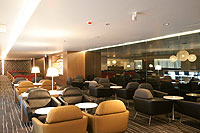 Qantas has unveiled its new business class lounge at Hong Kong International Airport replacing the current decade-old facilities.
The new lounge is available to all eligible Oneworld and Qantas business class passengers, as well as Chairmans Lounge, Platinum Frequent Flyer, Gold Frequent Flyer and Qantas Club members.
Qantas has incorporated "key design elements" including Moooi lighting and an Akira Isogawa rug, plus eleven bathroom and shower suites and 14 PC workstations. There's also free wifi internet access and power/data points are located throughout for use with laptops and other electronic devices.
Qantas said the new furniture and improved seating layout would give a "better sense of personal space" than the current lounge.
The existing lounge, which first opened in 1998, is due to undergo its own refurbishment and will open again next month in its existing location.
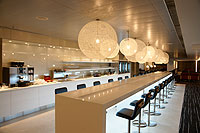 Qantas facilities at Sydney, Melbourne, Auckland, Perth, Narita, Los Angeles, and Honolulu have also undergone recent upgrades.
The new lounge is located on level five of the terminal building, and access is by lift or an escalator opposite Gate 15.
For more information visit qantas.au.com.
From Business Traveller
Emirates adds 17 new routes to Asia/Pacific region

On November 4 Dubai-based Emirates airlines announced a significant enlargement to the Asia/Pacific flight plan with the addition of 17 new flights.
The new flights, some daily and some weekly, will be added by January 2010, increasing the company's seat capacity in the region by 13 percent.
Some of the new routes include: a fourth daily service to Bangkok, a third daily service to Sydney, two more weekly flights to Manila and one additional weekly route to Jakarta.
Emirates added service to Luanda, Angola last week, the airline's 18th destination in Africa.
In 2008, Emirates was the seventh-busiest international carrier and in 2009 was voted the fifth-best airline in the world by research consultancy firm Skytrax.
In the last year the Middle East is the only world region which has defied the international air travel recession by recording an 8 percent increase in passenger demand over the first 10 months of this year, according to the International Air Transport Association.
From The Independent
Buy a ticket to the Philippines and get a free ticket to any domestic destination
Fly Roundtrip from Bangkok to Manila for THB 8,540 (All In Fare) and get free ticket to any of these exciting domestic destinations: Bacolod, Cebu, Davao, Iloilo, Kalibo, Laoag, Legaspi, Puerto Princesa, Tacloban, and Tagbilaran
To get your FREE domestic ticket, you must indicate your preferred domestic city as your destination.
Sample Itinerary:
Origin: Bangkok
Destination: Cebu
ALL-IN fare is inclusive of the Round Trip Basic Fare, Taxes and Surcharges, EXCEPT for taxes that are to be collected at the airport.
Class: Economy
Travelling Period: 02 to 30 November 2009 and 16 January to 10 March 2010 (for OUTBOUND TRAVEL)
Selling and Ticketing Period: 02 to 16 November 2009 Book and buy your tickets now on www.philippineairlines.com or visit PAL ticket office or travel agent.
Book a serviced apartment in the Philippines:
(in partnership with Moveandstay.com)
Location: Manila - Cebu
Thursday, November 5, 2009
Airline business booms in Phuket
 |
Following the plan by public and private agencies to enlarge Phuket International Airport, Thailand's second largest airport after Bangkok's Suvarnabhumi, for passenger comfort and improved facilities, the airline business is showing every sign of going well, especially when a number of air carriers are moving forward with their proactive marketing strategies for the upcoming tourism season of the Andaman coastline. Thai AirAsia, the Thai subsidiary of Malaysia-based low-cost carrier AirAsia, has designated Phuket as its second hub linking the new routes flying from and to the province, while it has launched additional charter flights servicing Phuket-Hong Kong, Phuket-Singapore, and Phuket-Indonesia's Medan routes. "We selected Phuket as another hub, as it is where (there is liveliness) even when the economy's down, the number of tourists has almost never dropped. Also, it's the destination through which most of our flights operate," said Thai AirAsia chief executive, Tassapon Bijleveld. "We picked this location as a hub and we're certain that there are many people in the region who want to fly directly to Phuket." Thai Airways International (THAI) is another carrier recently introducing a Phuket-Hong Kong route. "Flights flying to Phuket are expected to mainly generate revenues to the company. As you know, tourists flock here because of the province's potential. And if we operate a direct Phuket-Hong Kong route, passengers will definitely be assured of their convenience," said Chantouch Srinilta, THAI's district sales manager for Phuket. Apart from the two carriers, 'Happy Air', a local small airline, debuted with an introduction of short routes as continuations from Phuket to Hat Yai and Malaysia's Langkawi. The routes are to enable tourists to travel to nearby tourist destination in short journeys or a one-day trip. "We're also planning to fly a Phuket-Medan route, as Medan is as well a tourism city in Indonesia. We'll also be expanding (with) new destinations in several years if the market here goes well and if the feedback's good." said Patcharapol Sontipan, sales and marketing manager of Happy Air Travellers. "Our airline hopes to be Thailand's top carrier for tourism within the next five years". The bright prospect of domestic airline business expansion may not only buck the trend of the current economic downturn, but it also reflects the potential of the tourism and travel industry in this Andaman coastal resort island which may help prop up the country's economy in the future. |
From Thai News Agency
Wednesday, November 4, 2009
Fly Roundtrip from Bangkok to New York for just THB 33,050 All included
Fly Roundtrip from Bangkok to New York:
- Airline: China Airlines
- Price: THB 33,050* (all included)
- Class: Economy
Book now on Asian Trails website and travel until 15 December 2009
Book a serviced apartment in New York:
(in partnership with Moveandstay.com)
Apartment type: Studio - 1 Bedroom - 2 Bedrooms +
Location: New York – Chelsea - Financial District
- Airline: China Airlines
- Price: THB 33,050* (all included)
- Class: Economy
Book now on Asian Trails website and travel until 15 December 2009
Book a serviced apartment in New York:
(in partnership with Moveandstay.com)
Apartment type: Studio - 1 Bedroom - 2 Bedrooms +
Location: New York – Chelsea - Financial District
Air India inks pact with Singapore Airlines
Air India and Singapore Airlines have signed a bilateral agreement that would enable passengers of either carrier to earn and redeem miles on flights operated by the other. 
Under the new agreement, effective from Tuesday, frequent flyers on Singapore Airlines and Air India would be able to earn and redeem miles on flights operated by either carrier.
The agreement comes in the wake of efforts by the national carrier to fulfil the conditions of joining the Star Alliance, of which SIA is a founder member. Air India has already been invited to join the global alliance, which was formed in 1997 and has a membership of 26.
The agreement means that members of SIA's KrisFlyer programme would be able to earn KrisFlyer miles when they fly with Air India, or choose to redeem their miles for flights with the Indian carrier, an SIA statement said here.
Monday, November 2, 2009
PHUKET EARLY BIRD & LATE NIGHT FLIGHTS PROMOTION
One way flight from Bangkok to Phuket:
- Airline: Bangkok Airways
- Price: THB 1,390* (all included)
Book now on www.bangkokair.com until 15 November 2009 and travel now to 15 December 2009.
Book a serviced apartment in Phuket:
(in partnership with Moveandstay.com)
Starting from: TBH 1,500 per day
Location: Patong Beach - Kata - Kamala Beach
Apartment type: Studio - 1 Bedroom - 2 Bedrooms +
- Airline: Bangkok Airways
- Price: THB 1,390* (all included)
Book now on www.bangkokair.com until 15 November 2009 and travel now to 15 December 2009.
Book a serviced apartment in Phuket:
(in partnership with Moveandstay.com)
Starting from: TBH 1,500 per day
Location: Patong Beach - Kata - Kamala Beach
Apartment type: Studio - 1 Bedroom - 2 Bedrooms +
Cathay Pacific to launch new service to Jeddah

Cathay Pacific Airways has launched its new service to Jeddah, Saudi Arabia's second major commercial city, with an inaugural flight landed in the King Abdulaziz International Airport (KAIA) in Jeddah at 8:19am Saudi Arabian time on 27 October 2009 G (8 Dhu Al-Qa'dah 1430H).
The four-times-weekly service will operate through Dubai on the way to and from Hong Kong.
The new service, to be operated by an Airbus A330-300 aircraft in a two-class configuration, will increase the airline's presence in the increasingly important Middle Eastern market, connecting business and leisure passengers to Cathay Pacific's extensive international network through the Hong Kong hub.
Cathay Pacific launched its service to the Saudi Arabian capital, Riyadh, in 2001 and the number of flights per week was recently increased from five times a week to daily in response to sustained demand. The new service to Jeddah will offer Saudi Arabian travellers more flexibility and convenience when travelling to the Far East and beyond.
Jeddah is now Cathay Pacific's 46th online passenger destination and marks the airline's latest destination launch since Chennai in June 2008.
Cathay Pacific Airways Country Manager Bahrain, Saudi Arabia Mr. Daniel Cheung said, "We are very pleased to introduce Jeddah in our network. The launch of Cathay Pacific Airways new service to Jeddah is a sign of our commitment to the Middle Eastern region. We believe that this service will help foster a closer bilateral trade link between Hong Kong, Greater China and Kingdom of Saudi Arabia."
Engr. Mazen A. Al-Khashggi, Director General of KAIA, expressed his pleasure with the arrival of Cathay Pacific's first flight to Jeddah, and stated, "This step increases the variety KAIA is introducing to its passengers as part of its strategic plans to accommodate more travellers and airliners. And since it is the main gateway to the Two Holy Mosques and the main entrance for tourist and businessmen, KAIA is targeted by international airline companies."
KAIA accommodates the needs of 3 national airlines and 60 foreign airlines, implementing the highest levels of technical support and security measures for the aviation industry. KAIA is currently handling up to 18 million passengers a year and is expanding its capacity and capabilities, including new terminals, to allow for continuous growth in the number of domestic, international, pilgrims, tourist and business travellers.
44 Tips for Traveling Long Distance
Last year I traveled more than I traveled in my entire life. I've been on 4 continents and circled the Earth 2 times by plane. It was an exciting time, knowing my propensity for travel as a personal development tool, but it was also pretty draining. Never having long distance trips until that was definitely a huge roadblock for me. I had to learn on the fly (sometimes, literally on the fly). Somewhere between my 2nd and 3rd trip I started to write down some simple steps I should follow, sort of self directed tutorial. For your information, long distance traveling means for me one to two weeks trips which includes at least a transcontinental flight longer than 7-8 hours.
Here is a (hopefully incomplete) list of tips I gathered last year. Looking at it, I just know there is so much more to be explored, but I can't avoid a feeling of satisfaction and fulfillment for already being in all the beautiful places I've been so far. If you're an experienced traveler, this list will look like common sense, but if you're just starting out you may find out some simple, practical, yet most of the time underrated advice.
Packing
If possible, you should automate as much as you can. I'm easily bored, so packing is just not my stuff. Whenever I can put this on auto-pilot, I put it.
1. Make A Standard Packing List
And refine it every trip. I do have a minimal packing routine and I always start by getting it done first. After my minimum is done, I try to figure out what exactly I need in rapport to that specific destination: is it going to be clothing? Or maybe some specific medicines I should carry on? Sun glasses and sunscreen? I'm usually done in one hour, regardless of the final destination.
2. Pack Light
Especially when you're going long distance try to understand that you can't really take with you everything. Packing light means to have a bare minimum and then a little bit of extra. But not more. Most of the stuff you'll need in case of an emergency will be available at the destination too, so instead of carrying too much with you, better have a little more cash.
3. Have At Least 5 Kilos Less Than The Airplane Limit
Usually, the maximum accepted weight for a bag is 20 kilos. So, instead of trying to figure out how to reach that limit with more stuff from home, try to go with at least 5 kilos less. You will badly need those kilos for stuff you'll got home from the destination. On my first trip I had to actually leave some clothes to my friends to make room for some presents.
4. Load Your Digital Companion
I use my iPhone as my travel mate. So, I make sure I load it with everything I need just as I pack my bag with clothes and personal hygiene stuff. I put maps on the GPS app, audiobooks for the plane, make sure that I have enough space for photos and even load 1 or 2 movies just in case I get bored by the inflight entertainment system.
5. Take Some Meds
It's a good idea to have some light meds with you. Depending on where you go, taking some prophylactic shots in advance is also a very good idea. I usually carry some antibiotics, some bandaids and some digestive pills. I stick them in a pocket of my personal hygiene bag and I only verify the expiration date each time I get on a new trip.
6. Have And Use A Local Dictionary
Again, I use my iPhone for that and it does a great job. I have a number of dictionaries, especially for exotic countries, like Japan, or Thailand. Whenever I get the chance I exercise my language skills with locals. It's one of the best parts of my long distance travels. And since I'm not a native English speaker, I can also use a plain English dictionary as well.
7. Get An Universal Plug Adapter
They have different plugs in Europe, United States, Oceania or parts of Asia. It's better to get an universal kit that would become part of your standard list above, especially if you're part of the digital nomads tribe, as I am. You can get adapters for free during your stay in hotels but form the 3rd or 4th travel it's easier to just make it part of your baggage.
Planning
I like the feeling of randomly putting my finger on an Earth map, making that spot my destination. But between that gesture and the actual plane take-off there's a little bit of extra action. It's important and it's about planning.
1. Book Your Flight And Hotel Together
You will get some discounts if you do that and it's also easier to maintain the necessary documents. Having all the reservations in one plastic envelope makes it easier to access them on crowded and / or hectic airports . If your trip has multiple segments (flights + hotels) keep them in a separate plastic envelope.
2. Don't Create A Fixed Itinerary
Most of my long distance trips have been one week long. It's a shame to stick into such a limited time as many attractions as you can even before landing there. I usually go with my intuition and try to book some guided tours on the spot, if need will be. But most of the time I'm on myself. It's far more flexible and much more fun.
3. Plan Your Transfer From Airport To Hotel In Advance
It's very important to solve your transportation from airport to the hotel (or your accommodation of choice) in advance. Some of the airports can be pretty far (Narita is 1 and a half hour to center Tokyo by train, for instance) while others can offer limited on the spot transportation. A smooth transition to the hotel will also have a positive effect on your entire trip.
4. Don't Plan Anything Important In The First 36 Hours
You'll be pretty tired after a 9+ hours flight, not to mention that jetlag will most likely give you a hard time. I usually spend the first day and a half walking around the hotel, knowing the environment, finding local stores and transportation. Once I know my way around the hotel and I have a decent amount of food supplies in my room, I can go out and experience more.
5. Get Roaming On Your Phone
It's far more convenient than buying local calling cards. I use it because it helps me keep all the data in a central point, not mangling with several phones at once and also keeps me for making long, unnecessary calls. On the other hand, when there's a need to make a call, I can do it instantly.
6. Budget Your Local Currency Leftovers
You will have local currency leftovers. Meaning the small notes you end up with at the airport, when you're ready to leave that country and don't know when you'll going to be back again. During my first long travels those leftovers were in the 70-80 USD range. Quite a lot. After a little bit of exercise I reduced them at around 15-25 USD, which is basically a decent meal at any airport restaurant.
7. Identify Human Connections At Destinations
Find them on the Internet, on discussion groups, on blogs. Find some people you know in advance and try establish a connection with them. Not only they will become useful guides but they will also enhance your overall experience of traveling. It's not as much about visiting places as it is about making friends.
Destination
Knowing where you go is important, although keeping a little bit of mystery around is also pretty exciting. But there are several things I learned to do before and sometimes right after I get to my destination of choice.
1. Get Info About The Food
If you're on a special diet, as I was back when I was a raw foodist, get as much information as you can in advance. I overlooked this step only once, during my trip to Japan, and incidentally Japan is one of the most unsuitable places for a raw vegan to be. I actually had to break my diet during that visit and even after, so now I'm a little bit cautious on this one.
2. Assess Political Situation
I don't travel in hot areas of the world, but even if you don't do this on purpose, traveling long distance can get you close to hot areas (if your plane has been rescheduled for instance and you have to connect on a different airport in a different country). Assessing the political situation of the closest countries on your itinerary is a good idea.
3. Read Reviews On Travel Sites
But take them with a little bit of salt. I use only a few of travel sites, wikitravel being the most important one. Most of the time I'm just trying to get in the vibe, know the local habits, the local geography and cultural norms, letting the actual discovery to occur once I'm there.
4. Look Up The Itinerary on Google Maps
Especially on long distance trips this could be a very interesting activity. When I first come to New Zealand I actually didn't realize that I would have 2 10+ hours long flights. The segment between Bangkok and Auckland seemed like a few hours, when in reality was 10 hours. That made me a very loyal client to Google Maps ever since.
5. Follow Your Intuition
Don't always go for the famous places. Risk your time a little. The very best moments of my travels were the unexpected ones. I searched for a floating market in Bangkok (while the real floating market was 150 km away), got lost on some mountain roads while driving in Alps and got lost in a park near Danube Tower in Vienna.
6. Search For The High Points
Literally. Every big city has a high point. I've been on Eiffel Tour in Paris, France, on Sky Tour in Auckland, New Zealand, on Danube Tower in Venna, Austria, on Tokyo Tower in Tokyo, Japan and so on. There's something really special about climbing on those high points and see the city unfolding under your feet.
Flying
A big part of your long distance trip will be on a plane. Don't overlook this because you can't really sleep all the time. Besides, there are a lot of interesting things you can do on a long distance plane if only to make sure you'll arrive at your destination in the best possible shape.
1. Request An Aisle Seat
Even if you're going to be bothered by other passengers to get up and down, it will be good for your body. Not to mention that you have the freedom to get up and walk whenever you want. Unless you really want to look at the Earth from 10.000 meters every minute of your 10+ hours flight, take an aisle seat.
2. Don't Oversleep
It's not good for your body. Out of 9-10 hours of an average transcontinental flight, I found that maximum 3 hours of sleep are the best you can get. Oversleeping will have a very strange effect on your body and will make your jetlag fighting a little bit difficult. Try some light conversation instead.
3. Don't Abuse The Inflight Entertainment System
Every transcontinental plane has what they call an inflight entertainment system: movies, tv shows, documentaries, music or games. From my experience one of the best combos is maximum 2 movies and 1 documentary per flight. More than that is going to have quite an adverse effect on your brain. Balance the entertainment flight with some sleep, light conversation and discrete physical exercise.
4. Exercise Your Muscles And Joints
Doesn't necessarily mean you'll have to run to the restroom and back every 15 minutes (your flight attendants could be especially upset by such a behavior) but do try to activate some groups of muscles every half an hour. Your legs especially must be worked out, in a very discrete and effective way, but don't forget your shoulders and neck.
5. Get On The New Local Time
Once you're on the plane, set up your clock to the local time at the destination. If you had at least 3 weeks between your trips, it's a good idea to get on the local time with 1-2 days in advance, in order to reduce some of the jetlag. Regardless of that, once you are on the plane, think and live by the new time at the destination.
6. Prepare For Glitches
Flying is by far one of the safest and best organized ways of traveling, but this doesn't makes it perfect. Even flights can be delayed, or technical problems may postpone your flight with several hours or days, or you can jump into a bird. Be ready to face those situations and don't get panicked. Eventually, you'll get there, that's all that counts.
7. Fully Recharge All Electronic Devices Before Getting On Board
You will need your kindle, your iPod or your laptop. During the flight, your electronic devices can be a very good replacement of the inflight entertainment system, if you can't find something you like. Not to mention that you will need them functioning at your destination. Of course, you must switch them off during landing and taking off.
8. Take Off Your Shoes
This is not a joke. First time I saw some of my flight colleagues doing that I was quite surprised. But after 3 hours of hurting feet I finally understand. Don't worry about walking in your socks on the plane, it's much cleaner than you think and you'll get rid of those socks anyway. Having healthy feet once you get down from the plane is so often underrated.
9. Keep Your Tickets And Passports Handy
Don't stick them to the bottom of your backpack or handbag. Always keep them at hand especially when in the airport. You will need them at security checkpoints, at boarding and sometimes during the flight when you will complete arriving cards (various countries need some of those cards completed when you enter them).
10. Keep Your Tickets And Vouchers Available
I book electronically most of the time so I don't really have tickets but receipts and itineraries. I print them and I also print all the vouchers (most of the time for airport to hotel transportation). Don't underestimate the stress you'll experience in a foreign airport. Make sure you can react fast to any request regarding your tickets or vouchers.
11. Get A Name Tag For Your Bags
Many airlines are providing this at the check-out desks, but many still aren't. A name tag will have your exact name and address on it, gets attached to the bag handle and makes it much more easier to identify your baggage at the carousels.Your bag may look very much like another bag and in this case the name tag is the only distinctive element.
12. Keep The Flight Timetable Available
Again, I use my iPhone Notes app for that. For each long segment I write down my flight number, my plane type and the expected duration of the flight. It helps me gain a feeling of clarity in the middle of unknown surroundings. You may put it in a notebook or on a piece of paper. For me, it worked with the iPhone and helped me keep my head clear during 20.000+ km long flights.
13. Airports Are Part Of The Trip
I always enjoy walking inside airports, watching people and trying to get a glimpse of the local lifestyle. I don't take airports as transitory, tasteless points in my journey. Whenever I can, I try to connect with people, to visit interesting places, to get in airport lounges or to capture beautiful pictures of planes taking off or landing.
14. Hunt For Power Outlets
Some airports have designated places for charging electronic devices, some not. Whenever I am at a coffee shop or in a waiting room, I hunt for the closest place to a power outlet. And take it.
15. Take An Extra Sweater On Board
Although many airplanes are providing light blankets, on long flights the temperature can get pretty low. Better be prepared with an extra sweater. When flying at 10.000 meters for more than 9 hours, the cold combined with the lack of humidity can be pretty nasty.
16. Get Hydrated
The air in the plane cabin is extremely dry, due to the pressuring conditions. It's very easy to get dehydrated but it's also very easy to avoid it. Be sure to tell to flight attendants to get you water or juice every time you need it. Some prefer to take some moisturing creme for the hands or face, I've been ok without it, but your mileage may vary.
Accommodation
This is something really personal, so your choice may be different than mine, Regardless of the quality of the accommodations, and of the main goal of your trip, I found out that you will always need at least those 3 simple tips.
1. Look For Basic Hygiene
I usually book hotels when I know in advance where I'm going. In 99% of the cases hotels are clean and safe. But depending on the trip, budget and local context, I can book some bed and breakfast or even a backpackers hostel. Whenever I have to choose on the spot, I usually ask to see the room in advance. Saved a lot of frustration, many times.
2. Sleep Well
Don't overextend yourself by staying late, especially when you've been jetlagged. Sleep as much as you want, because you don't want to be hit by an unbearable need to sleep in the middle of a visit to some important attraction, or even when you're in a public spot, like a restaurant or coffee shop. Assess the room in advance and ask if it's quiet and / or sleep friendly.
3. Make Human Connections
I split my accommodation between hotels, hostels and bed and breakfast facilities. Every time I try to make some human connection with somebody there, being the concierge, the owner of the house or just some random sleeping colleagues in a backpackers hostel. The next step for this will be of course coach surfing but I'm not sure I'm ready for it. Yet.
Field Activities
This is what you're actually doing, the core of your trip. Of course, it's entirely personal so the only tips here are related to your interaction with the world, and how to streamline it as much as possible.
1. Get Local Currency As Fast As You Can
If you can get it with you in advance, that's even better. I travel mostly with EUROs and US dollars and that covers pretty much every part of the world. Be aware that exchange offices in the airports are usually much more expensive than the bank offices in the town, or have some huge commission. From my experience, it's always better to get local currencies at a local bank.
2. Update Your Itinerary Frequently
And by that I mean let your friends and followers in the digital world knowing where you are. I am a digital media citizen and I do update my itineraries as often as I can (meaning when I get some free wifi spots, data roaming being horrendously expensive everywhere in the world). It's good not only for letting your closest ones that you're safe and sane, but also for personal branding. I got a few interesting followers from each country I visited after some of my long distance travel tweets.
3. Know Your Surroundings
That goes hand in hand with the planning activity which says not to do anything important in the first 36 hours. I use those hours to know: shops around, restaurants around, walking areas and public transportation areas. If there's internet in my hotel room (99% of the cases, that is) I'm also browsing some Google Maps around my accommodation address to see the big picture.
4. Buy Day Or Week Long Public Transportation Tickets
If your planning was good, you should know in advance the costs of public transportation. In almost any of the cases, buying day long passes or even week long passes proved to be an incredible money (and time) saver. Depending on the local context you may use some exotic transportation, like Thailand tuk-tuk's but don't rely on them for getting fast and safe at a certain destination.
5. You Can't Have Enough Photos
Never. Traveling long distance is such an eye opening experience, in every way you look at it. I never know when I'm going to be back there, so keeping a strong visual record will always help me remember the best I can. Most of the time I use – again – my iPhone, but recently I took the habit of carrying with me a brand new Canon 450D.
Subscribe to:
Posts (Atom)